Posts

“Road Diet”: Losing Width by Retrofitting (Re-post from the Progressive Press)

(Re-posted from the Progressive Press. )  For most of the last century and continuing into this century, transportation planning in the United States has been mainly concerned with accommodating vehicular transportation. This automobile-oriented bias was embedded in travel demand forecasting models, transportation funding, zoning/subdivision regulations, street design ordinances, the general public and the general mindset of policy makers. The result in most cities has been a continual process of widening, and building new roads to alleviate traffic congestion due to increasing automobile ownership. What was not accounted in this automobile bias oriented transportation system was the detrimental impact that it would have on neighborhoods; making them dangerous for pedestrians and bicycles. Neighborhood residents and local commercial establishments  previously would have put up with the problems for a while but, eventually if they could afford it or their bus...

A ‘Smart City’ or the ‘Matrix’? (re-post from the Progressive Press)

Image
  (This article is re-posted from the Progressive Press. )  Cities are rapidly becoming engulfed in the technological revolution which is advancing at “warp speed”, rocketing the entire globe out of the post-industrial age into the emerging Information/Hyper-Global Age. The ability for the complex networked structures of a city (government, services, institutions, residents etc.) to effectively utilize its human capital, connect with the global economy, collaborate and use its infrastructure is becoming essential for its future welfare. This is being facilitated by the burst of technological devices and the Internet. In the Information Age, the most connected cities are becoming the most dominate, resting on their financial capability, their human capital and infrastructure (i.e., New York, London, Paris, Tokyo and Hong Kong). A city’s hinterland, its access to ports and manufacturing base, are becoming inconsequential to a city’s importance. All cit...

A Quiet Green Revolution: Urban Agriculture (repost from the Progressive Press)

Image
This article  is a re-post of an article that appeared 8 March 2013 in the Progressive Press: http://www.progressivepress.net/a-quite-green-revolution-urban-agriculture/ The mainstream media concentrates on the sensational and current news – obsessed with celebrity scandals, the daily fluctuations of the stock market, the deficit, and international conflicts – but under the radar is an alternative to industrial agriculture: the urban agricultural movement. The individuals and groups opposing industrial agriculture are not picketing, organizing rallies, destroying property, suing corporations; they are putting their hands in the dirt, straining their backs, enjoying quality organic food, and creating social capital by organizing diverse informal groups or non-profit organizations to forge a new future. In modern developed countries, we have left the growing of vegetables to industry. We go to our local mainline grocery store and buy produce (tomatoes, onions,...

Port cities viewed through fractal analysis (with special focus on land use formation around airports) Draft-Updated 30 December 2012

Image
(This image is the harbor road leading from the port to other land uses in the ancient Greek/Roman city of Ephesus , located   near Selçuk, Turkey. .   It was lined with shops which were selling goods that would be interested to those going to and from the port.   It is not by accident that Ephesus became a major center key in the spread of Christianity as it was a major cultural center in the Roman Empire.  When the port filled in with silt, the city declined rapidly.  This underscores the importance of key transportation nodes to the very survival of an urban areas.The image is located at : http://www.ephesus.us/ephesus/arcadianstreet.htm . This site also has a further description of the street and Ephesus.) I am still in the process of reading two books: Aerotropolis: The Way We'll Live Next (Kasarda and Lindsay) and Detroit City Is the Place to Be: The Afterlife of an American Metropolis (Binelli.)   Both speak of an evolving metropolis wh...

A tale of two cities: a city without guns versus a ‘gun toting’ city

Image
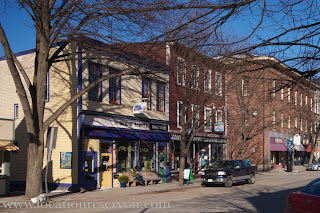
(This image is located at: http://locationreservoir.wordpress.com/2012/07/20/when-hollywood-takes-over-a-small-new-england-village-pt-2/ .   I selected this image to represent a small village or city as referred in the narrative below.) As a trickster and provocateur, I am proposing the juxtaposition of two hypothetical cities: one which prohibits guns and another that requires guns to be carried by all people.   In light of the current gun control debate brought about by the tragedy of Newtown, Connecticut, a discussion as the one below is warranted. The metaphors of utopia (or dis-utopia) is useful when discussing issues.   The most concrete way to discuss utopias is within the context of a city, which has been used by urbanists for centuries (i.e., Plato, Sir Thomas Moore. )   I will discuss this within a fictional situation of the two hypothetical cities. At the beginning of 2013, the city council of one city in the U.S. decided that the ulti...

2012 Volume of Urbana: Urban Affairs and Public Policy Now Published

Image
2012 Volume XIII (Click on above image for commentary) 2012 Volume XI II (on-line first)* Richard Hartwig and John Bailey JOURNALISM & ORGANIZED CRIME IN COLOMBIA AND MEXICO Regina Laisner THE ROLE OF INTERNATIONAL CITY NETWORKS IN THE SUPPORT OF LOCAL PARTICIPATORY GOVERNANCE IN LATIN AMERICA Ivani Vassoler-Froelich CITY GIFTS: A BOOK REVIEW OF TRIUMPH OF THE CITY: HOW OUR GREATEST INVENTION MAKES US RICHER, SMARTER, GREENER, HEALTHIER AND HAPPIER .  EDWARD GLEASER, PENGUIN PRESS, 2011 Michael A. McAdams IS JUSTICE IN THE CITY A QUIXOTIC DREAM?:   A BOOK REVIEW OF PLANNING AS IF PEOPLE MATTER : GOVERNING FOR SOCIAL EQUITY.  MARC BRENMAN,AND THOMAS W. SANCHEZ, . ISLAND PRESS, 2012. *Articles will be published  first on-line and later selected articles will be published in printed form.  **If using Mozilla Foxfire as a browser, it may be easier to download documents by pointing on the link for the article and rig...